Every time I have been late paying a bill, it wasn’t because I didn’t have the money, but because I forgot about it! My hunch is that most late-fees occur for that same reason. Back in those days when I lived in financial chaos, I didn’t have a system in place to help me remember to pay my bills.
For me this was just like playing roulette with my bills – I remembered to pay them sometimes and sometimes I would forget. It goes without saying that paying bills late (especially for credit cards) is terribly expensive. Most credit card companies charge something like $40 each time it is late as well as jacking up your interest rate to 25%.
Batching the Process
Anyone who has ever forgotten to get something from the grocery store realizes that it requires a lot less time to buy everything one day than having to go get something as you need it. It requires a grocery list and a bit of foresight, but it saves you hours throughout the week by NOT having to go back to pick up missed items. Why not implement the same type of planning to the paying of your bills?
Rather than sporadically paying them as they come in, or checking a pile on your desk every few days, you should be able to designate 2 days a month to pay your bills. And of course, if you want to save even more time use your bank’s online bill pay.
4 Steps to Manage your Bills
- Make a list of all of your bills. Next to each one right the day that it is due. If there is not a due date just leave it blank.
- Decide on 2 days per month that you will pay your bills. I recommend the 2 days you when you get paid (if you receive a regular bi-monthly check).
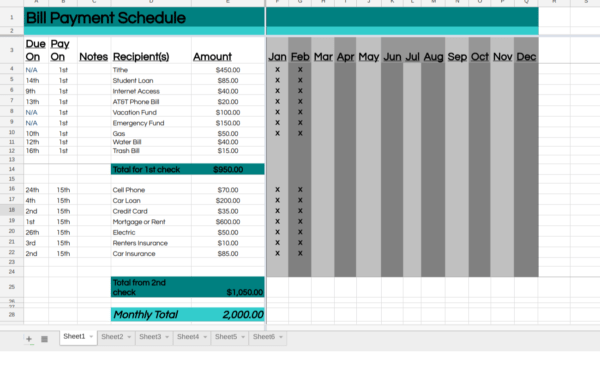
- Organize them by due dates. Assuming the days you get paid are the 1st and 15th – you would then take all of your bills due the 22nd through the 6th and pay these on the 15th. And on the 1st of the month you would pay the bills due from the 7th -21st. This will give each bill at least a week to get to through the mail.
- Figure out what your monthly dollar amount needed for bills is and divide it by 2. If you get paid $1000 two times each month, then you will want to pay as close to $1000 worth of bills on the 15th and $1000 worth on the 1st. Use the bills that don’t have a due date (i.e. savings accounts) to balance this out as best as possible.
Download a bill pay template
To see an example, download my bill payment schedule Excel spreadsheet. I also suggest having a designated checking account specifically to pay bills from. That way you can know exactly how much comes out (the monthly total of your bills), therefore you can know exactly how much to deposit.
Of course if your bill paying days don’t balance out perfectly (paying $1000 both days) don’t spend the money! If you paid $700 this time, you know you will have to pay $1300 next time. If you don’t touch it, you know it will be there waiting.

{ 29 comments… read them below or add one }
Hi,
I just wanted to drop you a quick note to let you know how much I have enjoyed your site today. I came across it this morning before church and was almost late for church because of reading your posts. My husband and I have made about $270k in mistakes and we are now paying dearly for it. I’ve started my own blog, not really for the purpose of helping others, but for myself so that I can have a visual picture of what’s going on with our finances. Most importantly, two years down the road see that I have been making progress.
I have been looking at other PF blogs for ideas on financial freedom, but I believe yours by far is the best. The reason why your site is far better is because you take a Christian perspective on money when most have a worldly perspective.
Again, thank you so much for the time and effort that you put in to this site. I pray God’s blessings on you in this ministry.
michelle
Hi Michelle-
I was wondering if I could get the address to your blog?
This is really great advice. I don’t know why I never thought of doing this. Thank you!
Hello! I just want you to know that I have learned a lot from your posts. Thank you so much for sharing your knowledge. God bless you.
Cathy,
Glad to hear it – I appreciate the encouragement!!
i think invest best az evry job…..and i wanna to business forever…and i like this
Thanks for your bill payment schedule document. This is exactly what I needed to remind me to pay my bills online and on time!!! A life saver.
This is a great spreadsheet to help figure out bills so there are no surprises. Any suggestions for those bills that we pay quarterly or annually? Or property taxes, we only pay every other month at the end of Jan, Mar, May, July? How would you suggest setting these up? Have you seen any way of doing that? Thanks
I divide annual and quarterly bills into a monthly amount. Then I add that “bill” to one of my bill-pay days and transfer the money to a savings account set up specifically for that payment. I do the same with saving toward large expenditures like the roof and gutters we will need, and a fake car payment (to ourselves) so we’ll have the cash on hand when the expense comes due. As we have fluxuating income, these “bills” get paid when ever we have the money that month.
I would like to thank you for your helpful information. You made it easy to read and understand. Thank you
Bjorn, Mary Hunt from debtproofliving.com has a solution for those infrequent but known bills that crop up. Its called the financial freedom account. To give credit where due, you should look this up on her site because she gives awesome, christian financial advice, and ways to save money too.
I would love to pay my bills on time and in full. Would love to tithe, but with my income from Supplemental Security and social security income of
$236. + $458. = $694. I am left with very little. my other bills like student loans and hospital bills get left behind. I do not have a car or home to fix up I do rent my trailer and the landlord does the fixing.
Every time I try to get a budget on line it has to many items on it and the amount of the income is way out there if you could please show me how I can use my income with your budget outlines I would love it
Oh what a blessing this is! I have been praying for the tools and resources to be a good steward of our finances, and this is looking to be just what I needed, thank you for sharing with us… God bless you!
i have read some of the comments but can not find your site to see if it can help me
Thank you so much for this help. I have only just begun with your spreadsheet. I have been a saver almost all of my life and have always tried to get my bills paid on time. But I have never been on a “budget”. I find this extremely interesting and helpful. I will certainly do my best to follow your advice. I have the discipline to follow through and I’m excited to watch the numbers change for the better. You are doing a great service. This is truly a blessing. Thank you again.
My husband & I have been renting for 4 years(current rent is $1095) and have recently started to build a home for ourselves & our two boys, ages 3mths & 3 yrs. We are under contract with a 1/1/1 by down, interest rate is 3.75% for 3 years & going up by 1%(locked in) the fourth and final years. It is a 30 year fixed mortgage ($1,400 monthly) & required no money down, and more than 6% closing costs were taken care of by the builder.
We do not have any student loans to pay off, his were paid off before our marriage & I had a 529 plan to pay for my entire schooling, we do not have any credit cards, & only 1 car payment of $375 a month. We have a small loan which we owe less than $4,000($157 monthly) & are on track to have it paid off in March(2 years less than originally taken out for) We recently took out another loan for $8,000($216 monthly) to pay off a line of credit which we never seemed to make a dent in with monthly payments because of interest. We are on track to have this loan & our car paid off within 3 years before our mortgage gets locked into a 4.75% interest rate, at $1519 a month.
I (24yrs old) have a 401K through work & also have a Roth IRA. My husband (34yrs old) recently just set his 401K up. Both 401′s are set at 5% which our company them matches.
Why is it that I feel our debt to society is so little & really could be much worse but I feel like we live paycheck to paycheck? I have always budgeted and we always have money to pay our bills & on time but I feel like we are scraping by. I’m nervous about taking on a mortgage. I have always budgeted and we do not impulse by, & we rarely go out/eat out. Our money seems to just pay for the monthly basics; groceries, bills, gas, etc. I’ve already figured & factored & budgeted & such, and really with taking on a mortgage & some utility consolidation and other costs of owning a home our bills will increase by only about $100. I guess I’m just looking for some reassurance that we are doing everything right & we are being smart about our finances.
I love your site & have found it to be very informative. I printed everything out & have lots of reading to do tonight. Thank you so much. God Bless
Hi ,
I just want you to know that I am grateful for all informative resource that you have provided .I just have my spreadsheet started reaching from annual to daily expenses that helps me visualize everything at a glance.What do you think am I on the right track?
Also ,can you elaborate little more on that article? “Take a renter ” I am kindly slow to get it cause recently if I am not mistaken ,there was an article that stipulate like the following “if you must take a renter ,you would better off consider a family member”.
To conclude ,how would I help get my spouse involve at least ninety por cent ?Any suggestion? Hope to read from you soon.May God bless you .
Jean Sanon.
Hi, I love how you have this set up, I’m trying to figure out how to make this work for my husband and I when we both get paid weekly. Any ideas?
Thanks!
When we both got paid weekly I simply paid about 1/4 of the bills each week. If you go with 2 monthly bill-pay days, and you’re following a budget, it should follow that you’d only spend what was budgeted for and the money for the bills would still be there on bill-pay day but you need to be disciplined enough to ensure that happens!
I just wanted to clear up a term mentioned above that can cause a lot of confusion if not used properly. Bob recommended that you set up a payment schedule that corresponds with your paycheck schedule, and this makes a lot of sense. However, he said to set it up with a “bi-monthly” time-frame. If something occurs on a “bi-” schedule, it happens every 2 time periods, therefore bi-monthly means every two months. What Bob meant to say is “bi-weekly”, which is every two weeks and is ultimately 26 times a year. If someone is paid twice a month, they are paid “semi-monthly” which ends up being 24 payments per year. I hope this helps.
Excellent point Arne. When we first set up a budget, my husband was paid on the 15th and 30th. Since then, he’s changed jobs and is paid every other Friday. We have set up our budget on a monthly basis with 2 paydays per month. Twice a year he gets a “bonus” of a 3rd payday in the month. This money is used for special purposes or to boost savings further.
These are great tips. I really like tips 2 and 3. I subconsciously have already been doing that, but since you pointed it out I noticed that is is very easy for me to keep track of my monthly spending. I actually just do everything once a month since my due dates pretty much fall in the beginning of the month. I noticed though that I still couldn’t keep track of where my money went so I created another spreadsheet to break things down further. http://moneyformyhoney.blogspot.com/2011/03/where-did-my-money-go.html
This looks like it’s going to be a great course, Bob. I’ve already been paying the bills twice monthly as that is how my husband gets paid. Generally, I pay everything out of one check except the mortgage, and the mortgage out of the second. Hopefully, tho, you’ll get to working with a variable income as that is where our trouble lies. Looking forward to day 2.
You would think this is something we should always remmeber since we are’nt the service provider but you are spot-on we forget for reason i can’t speculate, the steps are practical.
I have been doing this for years. I even budget out the “extras” so I know exactly how much I have left. The one thing I need to learn to do is pay myself. I pay my bills, my kids accounts, but not my savings account. How can I do a bettter job at paying myself first?
BPDB, I know what you mean – it can be a challenge, but the key is to get it out before the variable expenses get paid out. For us the variable expenses were entertainment, spending money, groceries, fuel for cars, etc. So we pulled out our most important items first and then let the rest of these just have to be limited to what was there.
Setting Google Calendar reminders is a great way to remember. You can set reoccurring reminders, etc. Have you tried this? I always try and set up automatic Bill Pay. However, the accounts I use Google Calendar when I can’t.
Jeff, great point. I actually do the same thing with Google calendar – it is a great way to make sure you never miss bill-paying day!
Yes..glad to have another Google Calendar bill reminder advocate. I actually handle my monthly bill organization within Google docs spreadsheet, so Google is my go to tool!
{ 2 trackbacks }